Description
Trade name:
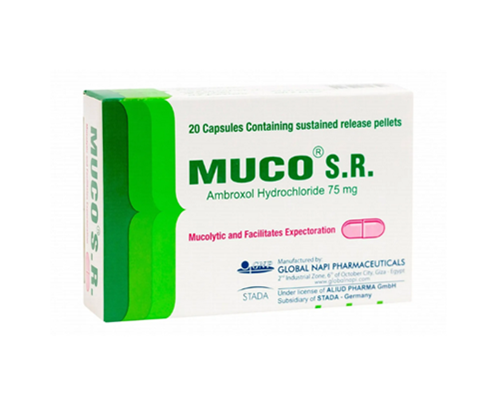
Muco S.R.
Compound:
Each capsule contains:
Ambroxol hydrochloride 75 mg
Auxiliary components:
Sucrose, starch, povidone, talc, gelatin, titanium dioxide.
Properties:
A mucolytic and expectorant agent, is an active N-demethylated metabolite of bromhexine. It has a secretomotor, secretolytic and expectorant effect. Stimulates serous cells of the bronchial mucosa, increases the motor activity of the ciliated epithelium by acting on type 2 pneumocytes in the alveoli and Clara cells in the bronchioles, enhances the formation of endogenous surfactant – a surface-active substance that ensures the sliding of bronchial secretions in the lumen of the respiratory tract.
Ambroxol increases the proportion of serous component in bronchial secretion, improving its structure and helping to reduce viscosity and liquefy sputum; as a result, mucociliary transport improves and sputum removal from the bronchial tree is facilitated.
When taking ambroxol orally, the effect, on average, occurs within 30 minutes and lasts 6-12 hours, depending on the single dose.
Indications:
Respiratory diseases accompanied by the release of viscous sputum and difficulty in expectorating sputum: acute and chronic bronchitis; pneumonia; bronchial asthma; bronchiectasis; COPD.
Method of administration and dosage:
Adults and children over 12 years of age: 75 mg once a day.
Contraindications:
Hypersensitivity to ambroxol or auxiliary components of the drugs; 1st trimester of pregnancy; lactation period (breastfeeding); congenital fructose intolerance (for dosage forms containing fructose); up to 12 years (for prolonged-release capsules).
With caution: impaired bronchial motility and increased mucus secretion (for example, with the rare immotile cilia syndrome); renal failure and/or severe liver failure; gastric ulcer and duodenal ulcer (including history); II and III trimesters of pregnancy; children under 2 years of age (oral solution; only as prescribed by a doctor).
Precautions:
Ambroxol should not be taken simultaneously with antitussives that can inhibit the cough reflex, such as codeine, as this can make it difficult to remove liquefied mucus from the bronchi.
Ambroxol should be used with caution in patients with a weakened cough reflex or impaired mucociliary transport due to the possibility of sputum accumulation.
Patients taking ambroxol are not recommended to perform breathing exercises due to difficulty in expectorating sputum. In patients in severe condition, aspiration of liquefied sputum should be performed.
Ambroxol should not be taken immediately before bedtime.
In patients with bronchial asthma, ambroxol may increase cough.
In patients with severe skin lesions – Stevens-Johnson syndrome or toxic epidermal necrolysis – a flu-like condition may be observed in the early phase: fever, body aches, rhinitis, cough, pharyngitis. In symptomatic therapy, mucolytic agents such as ambroxol hydrochloride may be erroneously prescribed.
Side effects:
Allergic reactions: rare – skin rash, urticaria, exanthema, facial swelling, shortness of breath, itching, fever; frequency unknown – anaphylactic reactions, including anaphylactic shock, angioedema, skin itching, allergic contact dermatitis.
From the digestive system: often – nausea; uncommon – vomiting, diarrhea, dyspepsia, abdominal pain.
From the nervous system: often – dysgeusia.
From the skin and subcutaneous tissues: very rare – toxic epidermal necrolysis (Lyell’s syndrome), Stevens-Johnson syndrome; frequency unknown – acute generalized eczematous pustulosis.
From the respiratory system: often – decreased sensitivity in the mouth or pharynx; rarely – dry mucous membrane of the respiratory tract, rhinorrhea; in isolated cases – dry mucous membrane of the pharynx.
Storage method:
At a temperature not exceeding 30 degrees. In a dry place.
Package:
The cardboard box contains 2 blisters of 10 capsules and paper instructions.