Description
Trade Name:
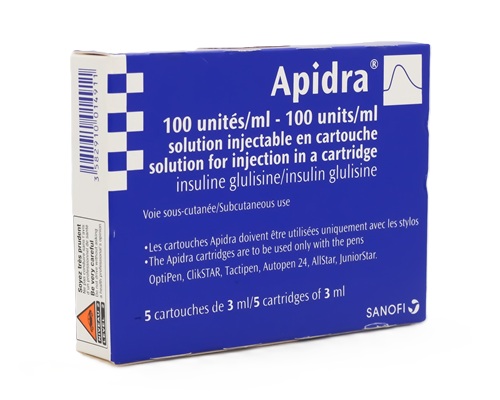
Apidra®
Insulin Glulisine 100 mg/ml
Solution in a cartridge for subcutaneous injection
5 cartridges of 3 ml
Composition:
Each 1 ml solution contains:
Insulin glulisine 100 Units (equivalent to 3.49 mg)
Each cartridge contains 3 ml of solution for
injection, equivalent to 300 Units.
Inactive ingredients are: metacresol, sodium chloride, trometamol, polysorbate 20, concentrated hydrochloric acid, sodium hydroxide, water for injections
Properties:
-Apidra cartridges are to be used only with the following pens:
-JuniorSTAR which delivers doses in steps of 0.5 units
-ClikSTAR, Tactipen, Autopen 24, AIIStar or AIIStar PRO which deliver doses in steps of 1 unit.
Apidra is an antidiabetic agent, used to reduce high blood sugar in patients with diabetes mellitus; it may be given to adults, adolescents and children, 6 years of age and older.
Diabetes mellitus is a disease where your body does not produce enough insulin to control the level of blood sugar.
Indications:
Type 1 diabetes
Type 2 diabetes
Insulin resistance
Diabetic ketoacidosis (DKA)
Gestational diabetes
Diabetes treatment during pregnancy
Dosage and administration:
Always use this medicine exactly as your doctor has told you.
Apidra is a short-acting insulin. Your doctor may tell you to use it in combination with an intermediate, long acting insulin, a basal insulin or with tablets used to treat high blood sugar levels.
If you switch from another insulin to insulin glulisine, your dosage may have to be adjusted by your doctor.
-Apidra is injected under the skin (subcutaneously), using a reusable pen.
Your doctor will show you in which area of the skin you should inject Apidra. Apidra can be injected in the abdominal wall, the thigh or upper arm or by continuous infusion in the abdominal wall. The effect will be slightly quicker if the insulin is injected into your abdomen.
-Apidra should be taken shortly (0-15 minutes) before or soon after meals.
-Before insertion of the cartridge into the reusable pen, the cartridge must be stored at room temperature for 1 to 2 hours.
-Do not shake or mix it before use.
-If you have injected too much Apidra, your blood sugar level may become too low (hypoglycaemia). Check your blood sugar frequently. In general, to prevent hypoglycaemia you must eat more food and monitor your blood sugar. For information on the treatment of hypoglycaemia, see box at the end of this leaflet.
-If you have missed a dose of Apidra or if you have not injected enough insulin, your blood sugar level may become too high (hyperglycaemia). Check your blood sugar frequently.
-Do not take a double dose to make up for a forgotten dose.
Side effects:
Serious: Hypoglycaemia, Systemic allergic reactions;
Other: Lumps under the skin;
Common: Skin and allergic reactions at the injection site;
Contraindications:
-Allergy to insulin glulisine or any of the other ingredients of this medicine;
-Hypoglycaemia)
Warnings and precautions:
- Apidra in cartridges is only suitable for injecting just under the skin using a reusable pen.
- If you have liver or kidney problems, speak to your doctor as you may need a lower dose.
Some medicines cause changes in the blood sugar level (decrease, increase or both depending on the situation). In each case, it may be necessary to adjust your insulin dose to avoid blood sugar levels that are either too low or too high. Be careful when you start or stop taking another medicine.
- Tell your doctor or pharmacist if you are taking, have recently taken or might take such medicines:
-Medicines that may cause your blood sugar level to fall (hypoglycaemia) include:
all other medicines to treat diabetes, angiotensin converting enzyme (ACE) inhibitors (used to treat certain heart conditions or high blood pressure), disopyramide (used to treat certain heart conditions), fluoxetine (used to treat depression), fibrates (used to lower high levels of blood lipids), monoamine oxidase (MAO) inhibitors (used to treat depression), pentoxifylline, propoxyphene, salicylates (such as aspirin, used to relieve pain and lower fever), sulfonamide antibiotics.
-Medicines that may cause your blood sugar level to rise (hyperglycaemia) include:
Corticosteroids (such as “cortisone” used to treat inflammation), danazol (medicine acting on ovulation), diazoxide (used to treat high blood pressure), diuretics (used to treat high blood pressure or excessive fluid retention), glucagon (pancreas hormone used to treat severe hypoglycaemia), isoniazid (used to treat tuberculosis), oestrogens and progestogens (such as in the contraceptive pill used for birth control), phenothiazine derivatives (used to treat psychiatric disorders), somatropin (growth hormone), sympathomimetic medicines (such as epinephrine [adrenaline], salbutamol, terbutaline used to treat asthma), thyroid hormones (used to treat thyroid gland disorders), protease inhibitors (used to treat HIV), atypical antipsychotic medicines (such as olanzapine and clozapine).
-Your blood sugar level may either rise or fall if you take:
beta-blockers (used to treat high blood pressure), clonidine (used to treat high blood pressure), lithium salts (used to treat psychiatric disorders).
-Pentamidine (used to treat some infections caused by parasites) may cause hypoglycemia, which may sometimes be followed by hyperglycemia.
-Beta-blockers like other sympatholytic medicines (such as clonidine, guanethidine and reserpine) may weaken or suppress entirely the first warning symptoms which help you to recognise a hypoglycaemia.
- Apidra with alcohol:
Your blood sugar levels may either rise or fall if you drink alcohol.
- Pregnancy and breast-feeding:
Inform your doctor if you are planning to become pregnant, or if you are already pregnant.
Your insulin dose may need to be changed during pregnancy and after giving birth. Careful control of your diabetes, and prevention of hypoglycaemia, is important for the health of your baby.
If you are breast-feeding consult your doctor as you may require adjustments in your insulin doses and your diet.
- Driving and using machines:
Your ability to concentrate or react may be reduced if:
-you have hypoglycemia (low blood sugar levels);
-you have hyperglycemia (high blood sugar levels).
- Keep this medicine out of the sight and reach of children.
Storage:
-Unopened cartridges:
Store in a refrigerator (2°C-8°C).
Do not freeze.
Do not put Apidra next to the freezer compartment or a freezer pack. Keep the cartridge in the outer carton in order to protect from light.
-Cartridges in use (in the insulin pen) may be stored for a maximum of 4 weeks below 25°C, away from direct heat or direct light and must not be stored in a refrigerator. -Do not use it after this time period.
-Do not use this medicine if it does not appear clear and colorless.
Package:
Carton box holds 5 cartridges of 3 ml each and an insert leaflet