Description
Trade name:
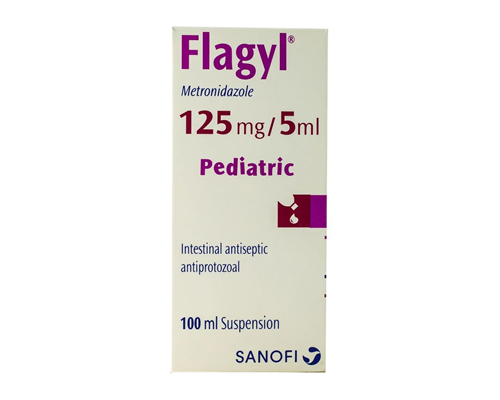
Flagyl
Compound:
Each 100 ml of suspension contains:
Metronidazole benzoate 4 g.
Auxiliary components:
Ethanol, sucrose, methyl parahydroxybenzoate, propyl parahydroxybenzoate, lemon oil concentrate, purified water.
Properties:
Antiprotozoal and antimicrobial drug, a derivative of 5-nitroimidazole.
The mechanism of action consists of biochemical reduction of the 5-nitro group by intracellular transport proteins of anaerobic microorganisms and protozoa. The reduced 5-nitro group interacts with deoxyribonucleic acid (DNA) of the microorganism cell, inhibiting the synthesis of their nucleic acids, which leads to the death of bacteria.
It is active against Trichomonas vaginalis, Entamoeba histolytica, as well as gram-negative anaerobes Bacteroides spp. (including Bacteroides fragilis, Bacteroides distasonis, Bacteroides ovatus, Bacteroides thetaiotaomicron, Bacteroides vulgatus), Fusobacterium spp. and some gram-positive anaerobes (sensitive strains of Eubacterium spp., Clostridium spp., Peptococcus niger., Peptostreptococcus spp.). The minimum inhibitory concentration for these strains is 0.125-6.25 μg/ml.
In combination with amoxicillin, it exhibits activity against Helicobacter pylori (amoxicillin suppresses the development of resistance to metronidazole). Aerobic microorganisms and facultative anaerobes are not sensitive to metronidazole, but in the presence of mixed flora (aerobes and anaerobes), metronidazole acts synergistically with antibiotics effective against conventional aerobes. Increases the sensitivity of tumors to radiation, causes sensitization to alcohol (disulfiram-like action), stimulates reparative processes.
Indications:
Protozoal infections: extraintestinal amebiasis, including amebic liver abscess, intestinal amebiasis (amebic dysentery), trichomoniasis (including trichomonas vaginitis, trichomonas urethritis). Infections caused by Bacteroides spp. (including Bacteroides fragilis, Bacteroides distasonis, Bacteroides ovatus, Bacteroides thetaiotaomicron, Bacteroides vulgatus): bone and joint infections, central nervous system (CNS) infections, including meningitis, brain abscess, bacterial endocarditis, pneumonia, empyema and lung abscess, sepsis. Infections caused by Clostridium spp., Peptococcus niger and Peptostreptococcus spp. : abdominal infections (peritonitis, liver abscess), pelvic infections (endometritis, fallopian tube and ovarian abscess, vaginal vault infections). Pseudomembranous colitis (associated with antibiotic use). Gastritis or duodenal ulcer associated with Helicobacter pylori. Prevention of postoperative complications (especially interventions on the colon, perirectal area, appendectomy, gynecological operations). Radiation therapy of patients with tumors – as a radiosensitizing agent, in cases where tumor resistance is due to hypoxia in tumor cells.
Method of administration and dosage:
For amebiasis, take orally:
Adults – 1.5 g/day in 3 doses and 30-40 mg/kg/day also in 3 doses (children) for 7 days. For giardiasis – adults – 750-1000 mg/day, up to five days.
children 2–5 years old – 250 mg/day.
children 5–10 years old – 375 mg/day.
10–15 years – 500 mg/day for 5 days.
For trichomoniasis in women (urethritis and vaginitis) — a single dose of 2 g or as a 10-day course of treatment — 250 mg 2 times a day and 1 vaginal suppository per day. For trichomonas urethritis in men — a single dose of 2 g or as a 10-day course of treatment at 250 mg 2 times a day. For non-specific vaginitis — 500 mg 2 times a day for a week. For anaerobic infections in adults — 1–1.5 g/day, for children — at a rate of 20–30 mg/kg/day. Intravenous administration is indicated only if administration cannot be done by other means or in severe forms of the disease. 100 ml (500 mg) of the drug is administered over 30–60 minutes.
Contraindications:
Hypersensitivity.
Pregnancy and lactation.
Precautions:
Long-term treatment should preferably be carried out under the control of the blood count. A false-positive Nelson test is possible, since treponemas are immobilized. Combine with caution with indirect anticoagulants, non-depolarizing muscle relaxants. Alcohol should be avoided during treatment.
Side effects:
Nausea, metallic taste in the mouth, anorexia, epigastric pain, vomiting, diarrhea, headache, dizziness, allergic reactions (urticaria, itching), leukopenia, peripheral neuropathy, with prolonged treatment with large doses, brown-reddish coloration of urine is possible.
Storage method:
At a temperature not exceeding 25 degrees.
Package:
The cardboard box contains a 100 ml glass bottle and paper instructions.